At age 17, my grandfather went with his parents to the local recruiting office
and signed up for World War II
To save his country, to save his family,
To do the right thing.
He wanted to be a pilot.
But the Navy didn’t need pilots, so he sailed away on a transport ship
Down the mighty Mississippi, through the Canal,
and into the endless blue of the Pacific
Not knowing whether he would ever see his family again,
The family he intended to save.
After the war ended, the much older 18-year old
Sailed on LST 652 into a Japanese harbor, the first Allied ship to enter the port
after the surrender
the start of the occupation
White cloths tied to the greenery onshore waved in the sea breeze
A massive aircraft carrier was under construction but no longer needed
Hundreds of Japanese sailors lined the edge of the ship in full dress uniform
waiting for them
silently
On command, every man on the carrier bowed to the waist in unison
My grandfather stood at the helm.
Finally, he returned to his family in east Texas,
Earned a college degree,
Met and married the love of his life,
Raised my mother and uncle in Wichita Falls,
Got a good job at the air force base
and even got to fly a little.
Years passed, and grandchildren appeared
He and his wife built a big house so all of us could visit,
A warm house with heated blankets, delicious food, laughter,
and almost more love than you could handle
Jerome Hines thundered “The Holy City” through their hi-fi system at Christmastime
And taught me what a bass voice could sound like
My grandfather retired while I was young,
So he had plenty of time to take us out for roller skating, putt-putt golf, movies,
Bowling, arcade games, underage driving lessons at the stadium,
and Japanese hibachi lunches
Plus they could drive down to see our recitals, plays, matches, and concerts
which was a treat once I began singing bass myself.
We often sat at the kitchen table, the whole family, and talked for hours –
Books, sports, war stories, history, politics, the goings-on of the family
Perhaps a bit odd for a shy kid like me,
But if I talked, he listened like I was the most important person in the world…
so maybe what little I had to say mattered more than I thought.
My senior year in college, when I got my first real job offer, I called my mom
and then my grandparents – always both of them –
because they genuinely wanted to know.
They had proven that my entire life.
A few years later, they moved to Irving to be closer to my mom and uncle
and all of the grandkids
We started getting married, raising our own kids.
When my wife went into labor with their first great-grandchild,
we were at their house
The house was different, but their kitchen table stayed the same
We sat at that table and talked for hours over lunch –
Books, sports, war stories, history, politics, the goings-on of the family…
and flying
He still listened like I was the most important person in the world.
Next summer, my wife and teenage sons will cross the Pacific
And sail around Japan, nearly 80 years after my grandfather did
Not for war, but to enjoy the freedom that my grandfather won for us
as a teenage boy who wanted to do the right thing.
As we pull into port, I’ll remember him standing at the helm of his ship,
barely older than my sons,
giving thanks that the war was over, that he’ll get to see his family again.
As we sail, I’ll give thanks as well
For one of the greatest men I’ve ever known
For the James Michener recommendation
For always sounding happy whenever I called or stopped by
For waving to us until we drove out of sight
For building us a fire on cold winter nights and letting us roast marshmallows
For teaching us to never stop reading and learning
For listening patiently without judgment
For the amazing prayers
For learning the Internet
For being humble, patient, and diplomatic no matter what
For loving Grandmother so well for their entire life together
For loving all of us more than we’ll ever know
Tailwinds and clear skies, Granddaddy. You finally got your wings.
Once I had a big voice. In my younger days, I sang bass in various choirs, acted a bit, and did some public speaking when necessary. I had to project my voice to the back of the room, and it worked. It’s a Box family trait. My dad, his brother and sister, and their parents all had strong voices. Perhaps I wasn’t always in tune, but you could hear me!
Things changed in January 2021. My voice became softer, hoarse and raspy, sounding like I had seasonal allergies most of the time. No specific start date or event comes to mind. I just started noticing a change. When my father-in-law and brother-in-law mentioned one night at a noisy Chili’s that I sounded sick, it became time to start looking for answers. My biggest fear was a tumor that was compressing a vocal nerve.
Spring 2021 – What’s Wrong?
I started with a local ear, nose, and throat (ENT) specialist. I’ll leave the office nameless because I’m not thrilled with how things went. After numbing me up, the doctor stuck a camera up my nose and down my throat to look at my vocal cords in action while I breathed, sniffed, and made various sounds. This is called laryngoscopy. A bit awkward, but not too bad. He didn’t notice anything terribly unusual about my cords at first, but he did see some irritation in my throat that he attributed to long-term acid reflux (GERD). I’ve had it for years and take meds for it. He and his PA put me on big prescription antacids and then a REALLY LAME, NO FUN low-acid diet (no caffeine, no alcohol, no soda, no spicy foods, low fat, no chocolate, etc.). Several weeks of that diet reduced the irritation in my throat. It did nothing to fix my voice but plenty to reduce the joy of living!
Ruling out GERD as the cause, we then tried CT scans of my neck and chest to check for tumors. Clean. Definitely good news, but we still didn’t have an answer.
After another peek at my larynx, the doctor diagnosed me with a malfunctioning right vocal cord, technically called vocal cord paresis. Vocal cord paralysis means the cord doesn’t move at all. Vocal cord paresis means the cord moves some, but not properly. Both conditions are caused by a nerve problem. Sometimes the body can repair the nerve damage over time, but it’s often permanent.
How the Voice Works
Above your windpipe lie two bands of tissue called vocal cords or vocal folds. When you’re not speaking, they form a V shape and lie open to allow air to pass through. When you speak, the bands come together and vibrate as air passes over them to produce various types of sound.
There are two nerves that control the voice. The superior laryngeal nerve (SLN) is shorter and raises the pitch, with a branch for each vocal cord. If that nerve gets damaged, your voice becomes more monotone and fatigues easily. The recurrent laryngeal nerve (RLN) runs down the neck into the upper chest and then doubles back up (hence “recurrent”). It controls the movement of the vocal cords and splits into a right and left branch, one for each cord. Since I could still vary my pitch and sing to some degree, we knew I had an RLN problem.
Damage to either branch of the RLN can produce a hoarse/soft voice like I have. Damage to both branches or damage above the split can cause problems with both cords. In some cases, both cords can become fully paralyzed, making it very difficult to breathe and demanding immediate medical intervention. Sometimes this nerve damage is caused by an infection or accidental injury during neck surgery, but in my case we didn’t know the cause. Medical people call these situations “idiopathic”. The right branch of my RLN just quit working properly.
Here is a video of a patient with a paralyzed vocal cord. Note that one cord moves back and forth while the other remains in place.
Summer 2021 – Daily Life
By this point, my voice wasn’t really getting any better or worse. It was just weak and inconsistent. It varied from day to day, throughout the day, and even from moment to moment. Speaking a lot tended to wear my voice out, so I lost some volume on days when I trained a new dispatcher or attended a social event, especially one that was loud and forced me to raise my voice to be heard. On the phone, I sounded almost normal thanks to the microphone near my mouth. But my voice didn’t carry well across a room and was hard to hear in noisy environments. At Six Flags, I had to get Jenny to order lunch for me because the people behind the counter couldn’t hear me. At a sporting event, or with someone who’s hard of hearing, I often needed to talk straight into their ear. That was fine for my wife but a little awkward for general interaction, especially during a global pandemic.
Except for a stint in management, I’d served as an on-the-job desk trainer in my dispatch office since late 2008. After all the drama with my voice, I finally stepped down as a trainer in September 2021. I talked a lot when I trained, and it wasn’t good for my voice or fair to my trainees to continue in that role.
Since I’m naturally an introvert and generally not talkative, losing some of my voice made me even less eager to speak and isolated me from others. Imagine how you would feel if no one could hear what you said. It felt like having a disability, and in a sense, it was.
August 2021 – New Doctor and Voice Therapy
The first ENT doctor was out of ideas by now, and I was also ready to move on. We agreed that I would switch to the UT Southwestern Voice Center, which has MDs and speech therapists who specialize in the voice. They often work with singers, speakers, and actors who need vocal help. My new doc, Lesley Childs, sang professionally for a while, and she’s extremely nice and has a positive attitude. Looking back, I wish I had gone straight to her. Voice disorders are uncommon, so it would have saved me some time to go straight to a voice specialist like Dr. Childs.
She did the same laryngoscopy procedure as the first ENT specialist, but more thoroughly. She noticed, especially when I laughed, that my right vocal cord didn’t move in sync with the left. She described the right cord as sluggish or flaccid. I should have told her that wasn’t a very nice word to use to describe a middle-aged man!
As expected, she wanted to start with conservative treatment before jumping to surgery. In some cases, the damaged nerve heals on its own within a few months, so many doctors hesitate to jump straight to surgery right away. So I attended several voice therapy sessions with one of their speech pathologists, a really nice guy named Jacob.
Voice therapy was interesting. We tried various exercises to give my voice more resonance, which would increase its power and volume. One technique was called straw therapy, which involved blowing into a normal straw for a bit prior to speaking. Like magic (actually through temporarily pressurizing the chamber below my vocal cords), it almost restored my old voice! But the effect lasted less than a minute before wearing off. It was fun to try but wasn’t a long-term fix. We tried other techniques as well – various humming sounds on different vowels and consonants, moving up and down in pitch, using my diaphragm more. All good techniques, but nothing changed the basic fact that my right vocal cord simply didn’t work properly.
Fall 2021 – First Injection – Juvederm
By October, my voice problem had been going on for about 9 months, and the odds were slim that the cord would ever function properly again. It was time for plan B – compensating for the loss.
My doctor recommended Juvederm injections into the vocal cord (injection laryngoplasty, in medical-speak). Juvederm (a brand of hyaluronic acid) is more commonly used to reduce wrinkles and plump lips, but it can also plump up a damaged vocal cord. The goal was to position the injured cord closer to the good cord so they could meet properly and allow more normal speaking volume. Juvederm is temporary in this situation, lasting maybe 4-6 months. She told me that afterward, my throat might be sore and my voice strained and tight for a few days, but once the swelling goes down, I should have a stronger voice.
If we were happy with the results, the next step would be a more complex operation next year to add a permanent implant behind my injured cord to push it toward the middle (medialization laryngoplasty). That way I won’t have to keep returning for injections every few months.
Voice Sample Nov 2 Before First Injection:
We did this in her office on November 2 with LOTS of numbing meds. It was a really quick procedure involving a fiber-optic camera up my nose plus a special needle down my throat for the injection. Once she started, it took maybe 5 minutes.
Immediately afterward, I discovered that I couldn’t really talk with my normal voice. Hmm. The only voice I could produce was a goofy falsetto that sounded like a combination of Mickey Mouse and Mr. Hankey from South Park. It cracked me up, so I made a video.
Nov 2, Just After Injection:
November 2021 – Recovery and Panic
I tried working one shift nine days post-surgery and sounded absolutely awful – still very hoarse, and the lower part of my voice simply wasn’t there. I sounded like a guy who was trying to sound female AND who’d been smoking for 50 years. Think Marge Simpson.
I started getting nervous. As a flight dispatcher, part of my job involves talking to pilots, operations agents, air traffic controllers, crew schedulers, and other coworkers within our operations center. Among other duties, I try to convince my pilots that I’ve given them a flight plan that they can trust, a plan that’s safe, legal, smart, and highly likely to have a good outcome. The route is solid. The fuel load is sufficient. If they call to discuss the plan, I use my voice to convince them I know my stuff and am confident in what I’ve given them. If I sound like I have the flu and ought to be in bed, it doesn’t give them a good impression.
I started wondering whether something had gone wrong, whether my voice was truly and permanently fried, whether I’d made a horrible mistake by getting this injection. Would I ever dispatch again? Did I need to start looking for a new job? Could my department find something for me that wouldn’t requiring talking to crews on live flights? As the primary income for a family of four, this was NOT a good feeling.
Voice Sample Nov 15 – 13 Days After First Injection:
Starting to panic, I went back to see the doctor two weeks post-surgery and got another scope done. She said my injected vocal cord was still REALLY swollen for some reason, which was why my voice hadn’t gone back to normal. She assured me that it would stabilize in time. I did my best to trust her expertise. By three weeks post-surgery, I was starting to sound closer to normal, although still not great. It was probably close to four weeks before I really sounded better than my pre-injection voice.
Voice Sample Dec 27 – 8 Weeks After First Injection:
It’s hard to tell from an iPhone recording, but my voice had more power and range at this point. People could hear me better in person. December and January were good months. I finally felt that the injection truly had done my voice some good and was worth the time, money, and drama. I didn’t feel disabled anymore. Friends would happily tell me, “Your voice sounds good!” But by the end of January, my voice began to slowly degrade as the Juvederm was absorbed by my body. It took a while for others to notice, but I could tell a difference.
March 2022 – Deciding the Next Step
In March, I saw Dr. Childs for a four-month checkup, expecting to schedule my implant surgery. She thought I still sounded pretty good, better than I thought I sounded. She scoped me again and saw that my right vocal cord still had a decent amount of filler left. She also noticed that I didn’t have a large gap between my good cord and my bad one. As a result, she didn’t recommend adding the implant yet. Instead, if I wanted any further intervention, she wanted to do another injection in May. But this time, instead of Juvederm, she wanted to knock me out, pull some fat from my belly (lipo!), and inject the processed fat into my cord. This approach would last a lot longer, possibly a year or more, and should be tolerated better by my body since it’s my own tissue instead of a foreign substance. After thinking about it for a while, I scheduled the surgery for May 19.
May 2022 – Second Injection (Fat)
We did the surgery my May 19 as scheduled at Clements Hospital in Dallas under general anesthesia. This process was much more involved (and more expensive!) due to the anesthesia and lipo, but still outpatient. Everything went well. I got a two-inch incision in my belly that stayed sore for a few days. My throat was a touch sore for about a day. However, this time my voice started out even worse than before. I could not speak above a whisper for a few days, not even in my goofy falsetto. After a few days, I could force out a bit of sound, but it strained my voice and sounded terrible. Now I’m waiting for my voice to stabilize so I can return to work.
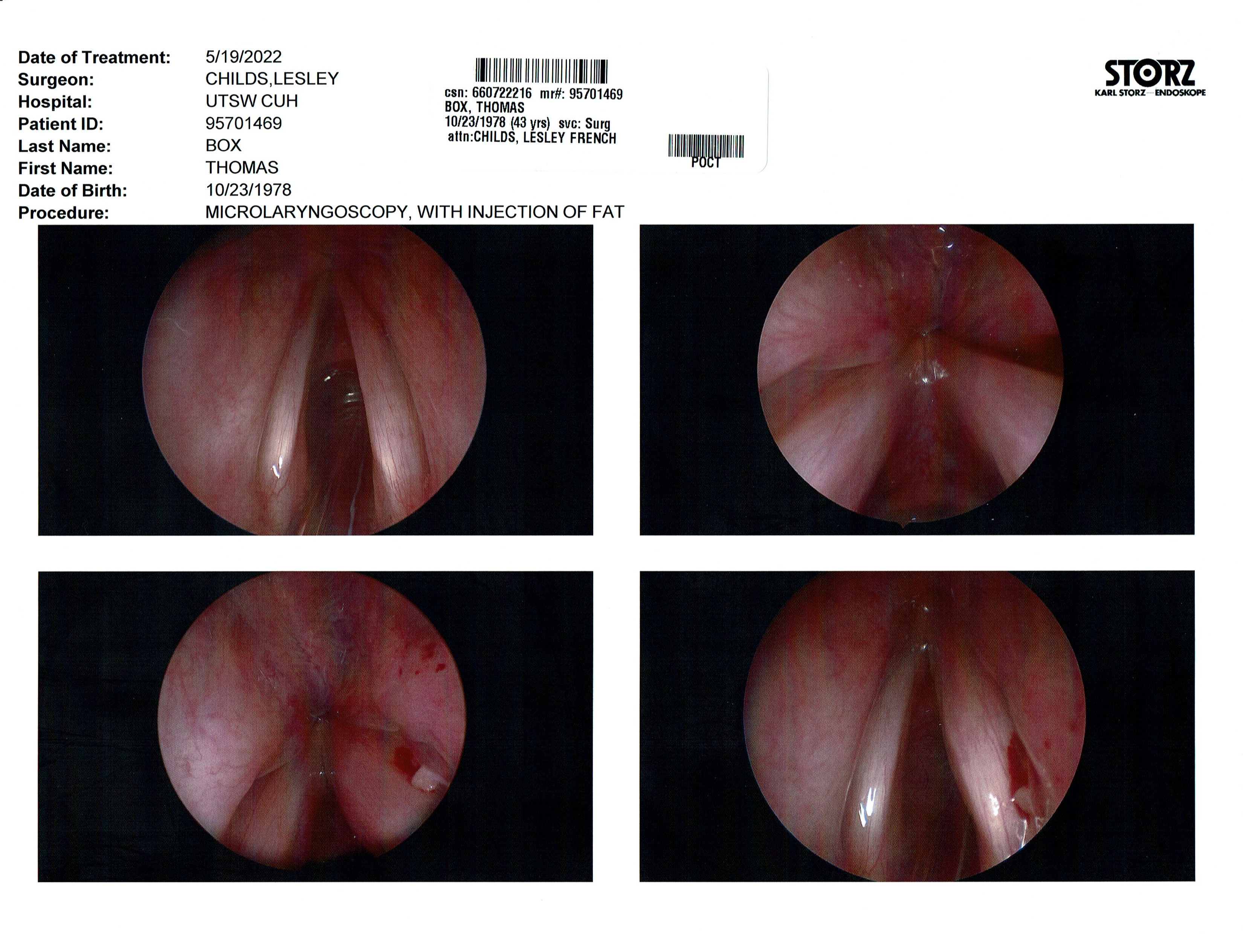
Dr. Childs took some nice before-and-after pictures of my vocal cords during the surgery.
Top Left: Pre-surgery resting state. Bad cord on right. Bit of leftover Juvederm from last surgery.
Top Right: Pre-surgery while making sound, so cords are together. Bit of a gap between them, hence the soft voice.
Bottom Left: Post-surgery while making sound. Less gap. Should produce more sound once I heal.
Bottom Right: Pumped-up cord on right. It will shrink a bit as swelling goes down and a bit of the fat is absorbed, but it should remain bigger than the left cord for a while. That’s what we want!
To those of you who have supported, tolerated, understood, and encouraged me on this journey, I offer my deepest thanks. This is a weird problem to have, and your support has helped me greatly.
Unlike the lithium-ion batteries in Teslas and some other electric vehicles, Nissan chose a cheaper, easier to manufacture battery for the LEAF that does not have a thermal management system. These batteries worked okay in cooler climates, but they often degraded quickly in hot climates such as Texas.
Anticipating this problem to some extent, Nissan conveniently added a battery degradation meter on the dashboard. It shows how much of the original capacity the battery still retains. LEAF owners watch that bar very carefully. As the battery loses capacity, the 12 bars gradually disappear. Once the meter gets down to 8 bars, if you’re still within the time and mileage specified in the warranty, Nissan promises to repair or replace the battery at no charge. For my 2016 LEAF SL with the 30 kWh battery, the warranty was good for 8 years or 100,000 miles.
I lost my fourth bar after 42,682 miles and less than four years, all spent in the Dallas-Fort Worth area where summer highs top 100 degrees several days each year. On Day 1, I had maybe 107 miles of range when fully charged. By the end, the real-world range had dropped to 65-75 miles, a drop of 30-40 percent. I lost a bar about every 10,000 miles. For comparison, after about 36,000 miles, my Tesla Model 3 has lost maybe 4-5 percent of its original range, thanks to the thermal management system.
LEAF Instrument Panel The meter on the far right shows battery degradation (8 bars out of 12). The larger meter to its left shows the current state of charge (full) and estimated range (80).
Excited to get a new battery but a little worried about whether the Nissan dealer would cooperate or turn this into a giant hassle, I took the car to Don Davis Nissan in Arlington. They kept it for a few days to run some diagnostics. I was disappointed but not surprised to find that neither of the two service advisors actually knew much about the LEAF or understood the battery degradation issue. Even the “certified LEAF technician” didn’t understand the degradation meter. I quietly hoped that this particular tech would NOT be the one who installed my new battery.
Finally they realized that yes, there are indeed only eight capacity bars left and I did qualify for a new battery. Then Nissan corporate approved it and ordered it for the dealer. Woohoo! It arrived at Don Davis a few days later, much earlier than expected. They took a day to install and charge it. So I got a brand-new battery for free. But that’s not the best part.
Nissan no longer replaces the 30 kWh battery with the same 30 kWh battery for these warranty claims. Instead, they install a 40 kWh battery. So I got an even bigger battery for free. Officially it’s 10 kWh bigger, but range increase is even higher than I’d expected. Right now my effective range seems to be 155-165 miles! Compared to the old and busted battery, the new one has more than doubled our effective range.
New battery shows all 12 bars and greatly improved range
In my one-year update on the LEAF back in 2017, I came down pretty hard on Nissan about the battery degradation issue. The LEAF was a good car with a big flaw, at least for drivers in hot climates. Yet despite my frustrations and fears, I must praise and thank Nissan corporate for not only honoring the warranty, but actually giving me a better replacement battery than they had promised. Going from 75 miles of range to over 150 is a game changer and makes the car much more usable. Thank you, Nissan.
Finally, for my LeafSpy friends, here are some of my stats by the end of the old 30 kWh battery with 8 bars and for the new 40 kWh battery with 12 bars:
My older son Brenden says I need to blog more, so…
As you probably know, COVID-19 has decimated the airline industry, among all the other havoc it’s wrought. Compared to last year, the TSA is screening about 95 percent fewer passengers each day, sometimes under 100,000 people nationwide. Southwest is hemorrhaging cash. Instead of our normal 4000-ish daily flights, we’re operating around 1000 and have parked a couple hundred aircraft. Even with the drastically reduced scheduled, our flights are still mostly empty. Currently the dispatch department is paying everyone their full salary but only staffing about half the desks to aid in social distancing.
Needless to say, this isn’t sustainable.
Fortunately, the changes at work have limited the spread. We’ve only had one confirmed case in our office, and it happened in March. However, it’s still strange and sad to see our headquarters look like a ghost town as the non-operational employees work from home and only half the operational ones are there. I dispatched an Oakland to Honolulu flight last week that had two passengers. That works out to two flight attendants for each passenger.
To preserve cash during this jaw-dropping downturn in travel, Southwest is offering its employees the chance to stay home for a month at a time with full benefits and a fraction of their salary. They’re calling it Emergency Time Off (ETO). After doing the math and discussing it with Jenny, I volunteered for May. As of April 26, I am on coronacationâ„¢ for six weeks. I return to work June 8.
Yes, this is going to sting, but we’ll be okay. I’m grateful to still have a job. Over 26 million people have lost theirs over the last few weeks.
Southwest in Crisis Mode
I started at Southwest in June 2001, fresh out of college as a rookie technical writer in the IT department. A few months later, another event shocked the industry and evaporated demand for air travel: September 11. All commercial flights were grounded for two days. Nobody knew whether people would want to fly again after that. Millions of people canceled their flight reservations. At any other airline, I would have been laid off immediately. But Southwest doesn’t believe in layoffs. Our leaders let me and every other employee keep our jobs, even though they knew the risk. By taking care of their people, they won my loyalty for life. And over time, people starting flying again.
This year, Southwest is facing the biggest challenge in our history. My coronacation is a little way for me to give back to the company that saved my career and has been so good to my family over the last 18+ years.
Life Before and After COVID-19
So…now what?
My pre-rona life was a lot more hectic. I worked a lot of overtime trying to chip away at the mortgage, save up for travel, pay down one car or save up for the next one, fund house projects, and save for the boys’ college. When I wasn’t at work, I drove the boys to and from the pool, watched their meets, stayed in shape by running and cycling, helped out around the house, and tried to get enough sleep. It was a nice life but very busy. When I had a day off that didn’t involve a meet or a family event, I felt a little guilty and disappointed that I wasn’t working overtime to get ahead. I’m supposed to be productive, dangit!
Enter COVID-19.
Only half of the scheduled dispatchers actually come in to work so we can have an empty desk in between each of us. Open shifts are covered not by overtime, but by the on-call people, so overtime is all but gone until this passes. I only worked 8 shifts in April. I was on-call for several other shifts but only got activated once.
The virus has impacted each person in their own way. It forced me to slow down, to breathe, to relax, to reevaluate my life and how I spend my time and what my priorities are.
Despite the stay-at-home order and various nagging questions, this has actually been nice. Our kids have a weekday routine – breakfast, workout, school, lunch, clean something, free time / family time, dinner. The boys no longer have swim/dive practice in the evening, so we can relax and hang out instead of driving back and forth to the pool three times each evening. I run or ride three times a week but don’t have to squeeze them after work or on a rare day off. I sleep more and am less irritable as a result. Jenny and I go on walks and talk and catch Pokemon. We taught the boys how to play spades and got smoked by them in Super Smash Bros. I introduced them to a couple of my favorite movies. We might do a Lord of the Rings movie marathon like Jenny and I did before the boys came along. I cleaned out and reorganized the garage and linen closet, knocked out the huge pile of filing I’d put off for far too long, and diagnosed and replaced a bad circuit breaker that was turning off our fridge. I’ve FaceTimed with my mom and my 93-year-old grandfather. I finished a fascinating book called A Woman of No Importance, which is about an American woman with one leg that served as an amazingly effective spy in France during World War II. My next goal is to finally finish reading the novel version of Les Miserables (too many words, Victor Hugo!!!), the basis of my favorite musical. I also hope to dust off my guitar and see if my fingers still work.
The other day I ate lunch alone on the porch – no electronics reminding me that society is collapsing, no one to talk to, just me and a gorgeous spring day. The sun was out. A healthy breeze rustled the trees, shimmering in various shades of green and full of life. A pair of beautiful red-shouldered hawks swooped in and perched on our fence. That brief half-hour of quiet reminded me that life is indeed going on, even with the deadly virus, and that I get to choose what to focus on.
This feels a bit like retirement, except that my kids are still young and my body still works. So although it won’t be much fun financially, I am grateful for the opportunity to help Southwest and to spend so much time relaxing and enjoying life with my family as we try to stay healthy and sane.
On the bright side, it’s easier to save money when you aren’t supposed to do anything. We had booked and largely paid for a summer camp for the boys and a trip to San Francisco for us in early June. COVID-19 has canceled both of them, which (sadly) freed up some funds. Their swim and dive clubs are on hiatus, which saves cash. We’re deferring expenses, canceling extra mortgage payments, eating out much less, reducing our contributions to the boys’ college funds, and burning some of our savings that we can use to get through May.
I’m also well aware that we’re in an extraordinarily privileged position just to have the option to help my employer survive by taking a month off.
The boys are taking it pretty well. Jonathan, our social butterfly, really misses people. Jenny and I are trying to accommodate him by spending time with him each day – cards, chess, video games, bike rides, trampoline time, art projects. Brenden, our introvert, doesn’t feel as lonely but laments that he hasn’t been inside another building besides our house in over a month. Both miss being in the pool. In a pleasant surprise, they’re spending more time playing with each other. Sometimes it’s Minecraft or Super Smash Bros. Sometimes they just hang out on the trampoline, talking and batting a ball around. They’re having little trouble with online learning except for occasionally overlooking an assignment, which Jenny and I try to catch.
Jenny is a little stir-crazy. She’s reading a lot (thank you, Kindle Unlimited!), working on some art, and trying to keep the boys on track. She hits the grocery store every 7-10 days, trying to make each visit count. She and her family send each other short video updates via the Marco Polo app to stay in touch. Since her hospital has banned in-person classes, she and her partner are converting most of her classes to online format via Zoom. Her first one was the full-day childbirth class earlier this month, and it actually worked fairly well.
So in a nutshell, we’re doing okay.
Questions That Make Me Squirm
Although this time isn’t all bad by any means, some dark and uncomfortable questions bubble up throughout the day. Questions like:
The big one that few want to consider: what if we never find a way to become immune? What if there is no protective immunity after one gets the disease? Despite our hopes and assumptions, so far there’s little evidence of it in people who have recovered. What if herd immunity isn’t possible? What if we never develop a vaccine? Some viruses still don’t have a vaccine despite years of effort, including norovirus, RSV, MERS, the Epstein-Barr virus, and HIV. Flu has one, but since the virus mutates so much, we have to keep getting flu vaccines annually, and each year’s formula never works 100 percent effectively.
How and when will the economy recover from this? How many jobs will never return, particularly in small business, brick-and-mortar retail, restaurants, bars, clubs, live sporting events, concerts, and other sectors that bring together large groups of people?
Will people ever want to fly again at the same level they did before? What would make them feel safe enough and confident enough to get back on an airplane? Will Southwest need to shrink permanently? If so, how many of my friends, including people I’ve trained, will lose their jobs? That will be the last resort, but Southwest can’t go on like this forever. For many of us, dispatching for Southwest is our dream job, and I want every one of our new folks to stay if possible.
Will it ever be safe to hug my grandparents again?
Reasons to Hope
Despite these worries about things I can’t control, all is not lost. People have come together to fight this disease like I’ve never seen. Healthy people are choosing to stay home, keeping their distance, and wearing masks to protect others. Essential employees put their lives at risk every day to treat the sick, keep the lights on, fly vital supplies and workers to the people that need them, and keep food in everyone’s bellies. We’re learning about who we are, what’s important, and where we are vulnerable. And a lot of really smart people are working hard to end this crisis with the least possible damage. We are a strong species. We learn, adapt, and persevere. And we’re not giving up.
I’m not a traditional car guy. I don’t fix up old cars, change my own oil, or know all the stats for the newest Dodge Hellcat. But I am an electric vehicle (EV) guy. And in Nov 2018 I finally bought the car that I’d wanted for years but bailed on: a Tesla Model 3. After driving it for nine months, it’s time to tell the Internets about this amazing vehicle.
Simply put, this is the best car I’ve ever owned or even driven, and I love it.
Ordering a Tesla
Tesla offers car buying for the Amazon era. I went to Tesla.com, logged into my account, chose my options, and gave them a credit card number for a deposit. That’s all it takes to order one. No annoying salespeople. No even more annoying finance and insurance person. No haggling over the price or interest rate. You just order it like you’re ordering a new iPhone. When my car was ready, Tesla notified me, and I wired them the money and signed some papers at home. Then I picked it up at the service center in Dallas by Love Field. It was a touch more complicated than this, but it was easy enough that I never want to buy a car from a traditional car dealer again. This is how car buying should work – EASY.
Yes, they do offer financing and take trade-ins like a normal dealership if needed.
The Car
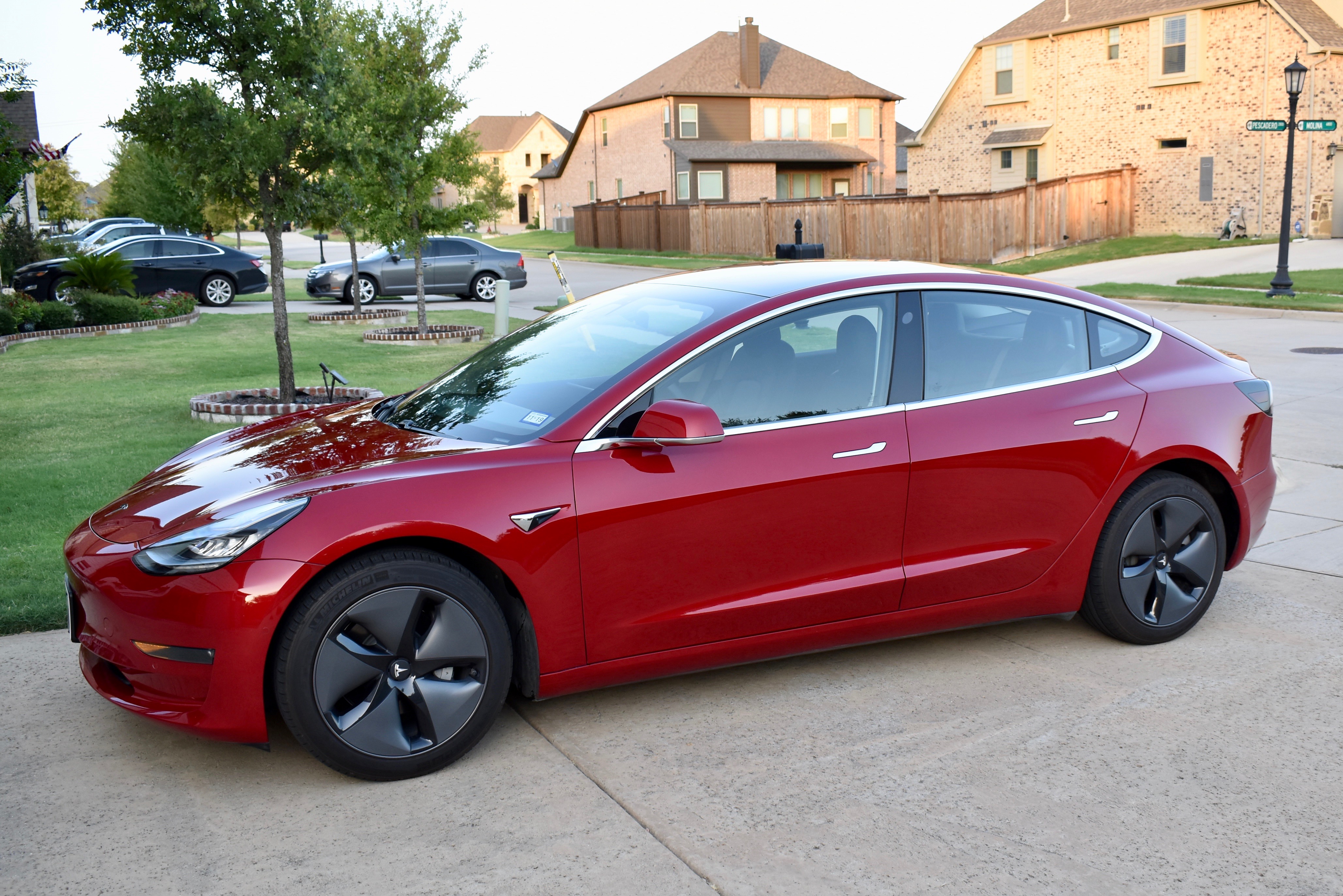
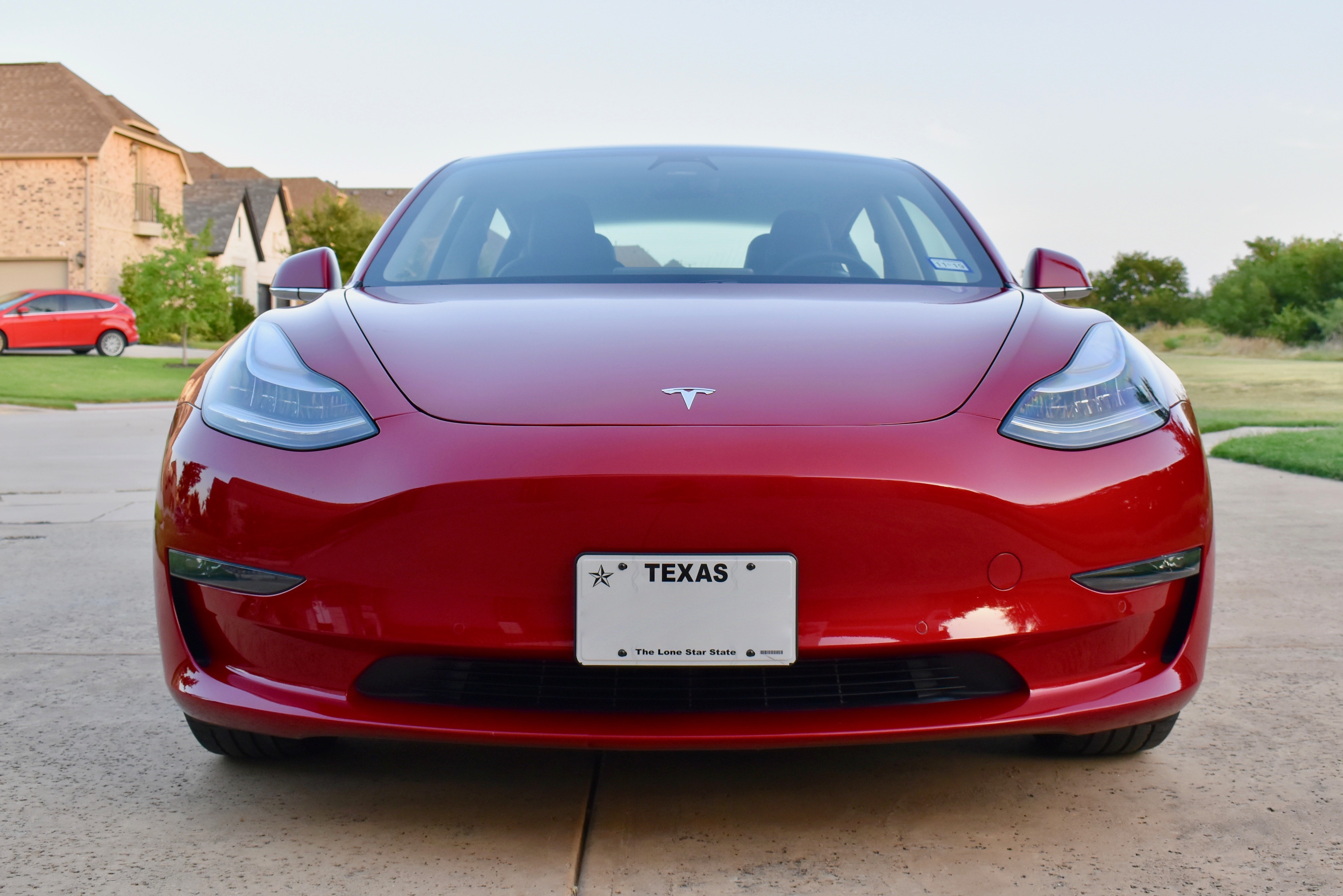
My Model 3 is named Ygritte (ee-grit) after the feisty redheaded wildling woman who convinces Jon Snow to forsake his vows in Game of Thrones. You can actually name your car through the touchscreen, so I did.
She is a 2018 long-range dual motor Model 3 with red paint, dark gray interior, 18″ wheels with aero covers, premium interior, and no autopilot (more on that later). The two electric motors (front and rear) produce around 350hp combined, producing a 0-60 time of 4.4 seconds. The Performance version can hit 3.2 seconds, but The Boss nixed that idea – something about having teenage drivers in the house soon.
Anyway, instead of a traditional transmission with gears, the electric motors produce smooth acceleration at any speed with no shifting. You step on the accelerator, and the motors spin faster. Electric vehicles drive very smoothly in general, but the 75 kWh battery and dual motors give this one a lot more power than my Nissan LEAF. Although I seldom take full advantage of the power, I love knowing it’s there in case I get into a tight spot. The handling is confident and sporty with a low center of gravity, and the dual motors provide all wheel drive for additional confidence. She is a BLAST to drive.
Interior
The interior tends to shock people who aren’t familiar with it. Tesla ditched the traditional instrument panel in favor of a radically minimalist design that features a giant tablet mounted in the center of the dashboard. The tablet shows your speed in the upper left, still comfortably within sight, along with the battery life and a situation display that shows nearby vehicles and people. The rest of the screen shows a high-res navigation display (map or satellite) and/or your audio choices, which include HD radio, Bluetooth streaming from your phone, or (my favorite) Slacker commercial-free streaming audio via the car’s LTE connection. Slacker seems to be free for at least the first year and offers dozens and dozens of channels. I thought SiriusXM offered a huge variety of stations until I experienced Slacker. I can switch among 2000s hip-hop, Renaissance choral music, 90s hard rock, movie scores, and a Kacey Musgraves station with a few taps on the screen. The audio system is the best sounding car audio I’ve ever heard, with 14 speakers, 1 subwoofer, amazing clarity, and perfect balance.
The rest of the interior maintains the minimalist vibe while remaining quite comfortable, with nice touches like LED lighting for the rear seats that allow the boys to read in the dark, an all-glass roof, soft synthetic leather that feels real, and USB outlets for the front and back seats to charge electronics.
Integrated Touchscreen with GPS Navigation and Satellite Maps
Streaming Audio from Slacker – so many stations with no DJs or commercials
HD Backup Camera
Fun Stuff
Romance Mode – On-demand fire, romantic music, and the front heaters turn on to set the mood…although regardless of what you might be planning, the car gets really hot really quick.
Fart Mode (officially Emissions Testing Mode) – fun for the whole family! You can surprise unknowing guests by blasting one from their nearest speaker and then calling them out. BRENDEN!!!!!
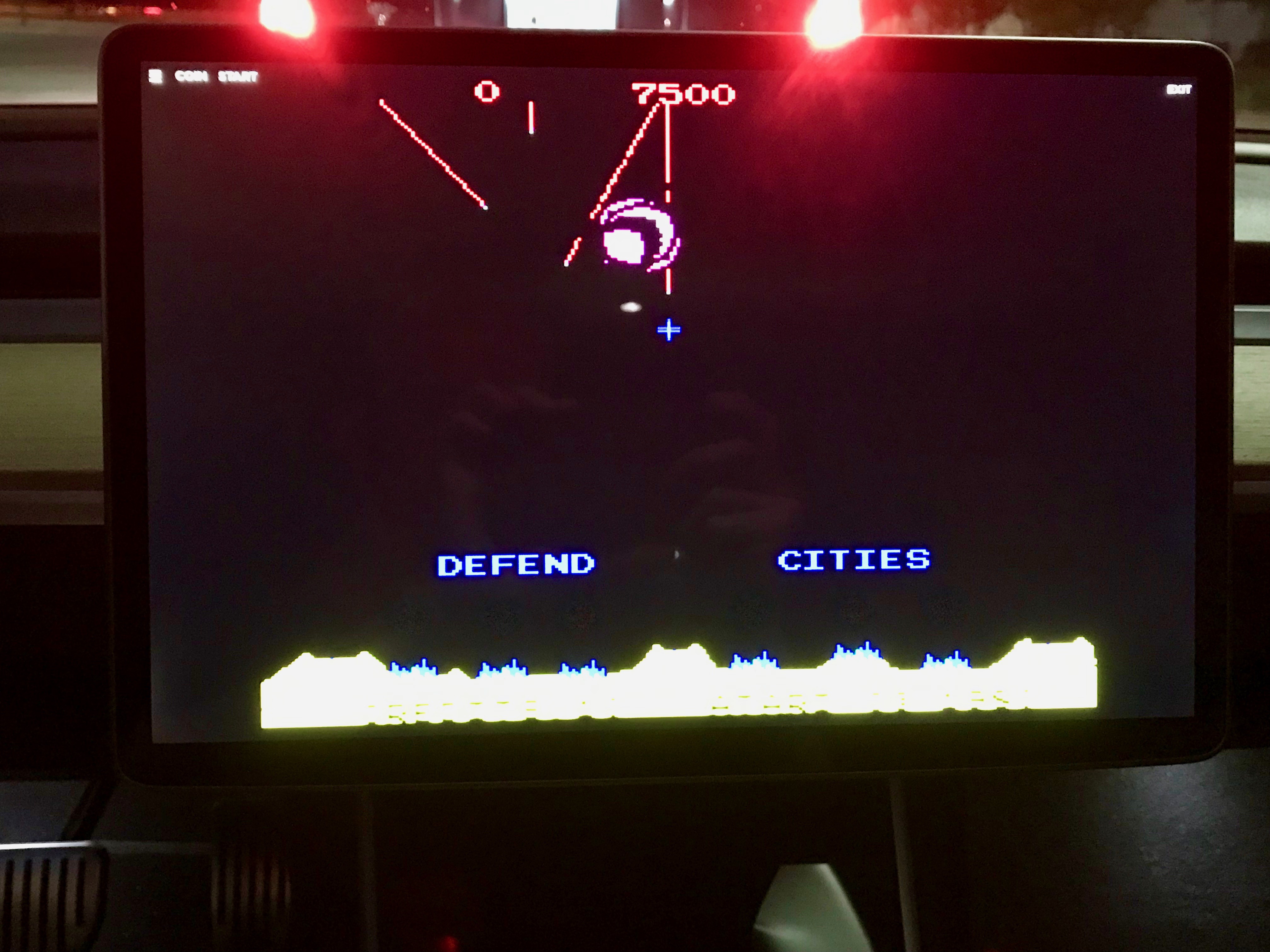
ATARI Games – Yes, when the car is parked, you can play a variety of ATARI games on the touchscreen, including Missile Command and Centepede.
Frunk – Without a big gas engine under the hood, Tesla added a small storage compartment in the front trunk, or frunk.
Range and Charging
Like with the LEAF, I nearly always charge at home with my JuiceBox Pro charging station, preferably during the day so I can use the solar panels to provide much of the power. Unlike the LEAF, I have about 300 miles of range instead of 75-90, enabling us to use the Tesla on road trips to Houston and San Antonio with no problem. Some days I don’t even bother charging after work because I don’t need to; the car still has plenty of range left. The range is probably the most significant improvement over the LEAF, which is a great car except for its battery.
The EPA rates the long-range Model 3 at the equivalent of 126 mpg. Lifetime, I’m averaging about 260 wH/mile or 3.8 miles/kWh. As I explained in more detail in my first post about our Nissan LEAF, the cost of electricity for an EV is roughly 25-40% of the cost of gas to travel the same distance. EVs use more electricity in winter due to heater use and reduced battery efficiency.
Road trips in the Model 3 are very possible because of Tesla’s nationwide network of Superchargers, extremely high-speed charging stations sprinkled along major highways and metropolitan areas. Whereas at home I can add around 37 miles of range per hour of charge, a Supercharger can charge at 250-400 miles per hour depending on the conditions. On our recent road trip to Galveston, we started off full and drove from Grand Prairie to Huntsville, reducing our range below 50%. There we plugged into the Supercharger and ate lunch at a great Mexican restaurant nearby. By the time we’d finished lunch, the car was full again. Road trips do take more planning in an EV versus a gas-powered vehicle, but they are possible in a Tesla. As EV adoption increases over the next few years, we should see more and more charging stations. Tesla’s website includes a map of their Superchargers. I’m still waiting for them to add one in Wichita Falls, where some of my family lives.
People like to ask what it costs to charge, which is hard to answer because you hardly ever charge from nearly empty to full. If you did for some reason, and your electricity costs 10 cents per kWh, filling the 75 kWh battery at home would cost about $7.50, maybe $8.00 when you factor in the power lost to the charging station itself. If you charge in public at a Supercharger or a slower Level 2 charger, the cost might be higher or lower. Collin Street Bakery outside Waco, TX, offers free Supercharging plus a free cup of coffee or tea while you charge. Other Superchargers might charge me $7-9 to add 200-250 miles. Some businesses, including Southwest, offer free Level 2 charging for their employees so they can charge at lower speed while at work.
Autopilot
Tesla’s self-driving features have created much confusion for a variety of reasons. First of all, Teslas are not yet capable of fully driving themselves yet. Full Self Driving (in Tesla parlance) hasn’t been released, and the regulators have not approved it. But that capability is coming. They keep refining the software and adding capabilities to the self-driving and other features, and they push those updates to the car via wifi.
What Teslas do offer, if you’re willing to pay extra, is a wealth of advanced driver-assistance technology that will help enable full self-driving in the future. I did not buy those features. However, they did give me a one-month trial. Autopilot is actually a decent name IF you use it in the aviation sense – a computer that automates mundane tasks while you (the driver/pilot) stay alert and monitor it, ready to take over at any moment.
Here are a few thoughts:
Autosteer – It really does keep you centered in your lane, which reduces the stress and fatigue of driving, particularly on long trips. It will also change lanes for you if the lane is clear and you command a lane change. HOWEVER, it still has some bugs to work out. Once it took a corner too tightly for me and scraped my right front wheel, which I really did not appreciate. It also got confused by highway onramps and temporarily veered to the center of the combined lane instead of hugging the lane marker on the left. Note: this feature is now included on all new Model 3s.
Traffic Aware Cruise Control (TACC) and Autobrake – TACC worked really well. It lets you set a desired speed but temporarily adjusts as needed if the car in front of you slows down. Once it moves, the car returns to your preferred speed. If the car in front of you stops, your car stops as well. Very cool and less stressful than traditional driving once you get used to it. I never got a chance to experience the emergency braking. Note: These features are now included on all new Model 3s.
Autopark – Couldn’t get it to work, but in theory it will parallel park or back into a space for you.
Navigate on Autopilot – When you enter a destination into the nav system and engage autopilot, the car uses Autosteer and TACC plus automatic lane change to drive for you from highway onramp to highway offramp. Handling of stop signs and stoplights is coming later this year, moving Tesla one step closer to full autonomy.
I might pay for some or all of the autopilot features in the future. They intrigue me but aren’t currently worth the money to me, especially while Tesla is still working out the bugs and improving the software. Someday I’d love to read a book or nap while my car drives me to work.
Downsides of Tesla
No company is perfect. Tesla, as you might have heard, has a history of overpromising, particularly with regard to timelines. Model 3 production didn’t ramp up quite as soon as Musk predicted, but they eventually reached their goal of rolling out thousands per week. I wish them luck as they continue to expand production of these amazing vehicles.
A bigger problem for them right now is their insufficient service centers and parts. They simply haven’t ramped up their service capabilities as quickly as their production, leading to long waits for repairs. Call it growing pains. For instance, back in January I made an appointment with them to investigate a minor squeaking sound in the rear of the car. I dropped it off on a Wednesday, I think. They gave me a rental car and told me they were so backed up that they might not even get to look at it until Monday or Tuesday of the next week. So 1) they took nearly a week to fix a simple problem, and 2) they wasted a lot of money buying me a rental for several days instead of simply having me bring in my car when they were ready to work on it. I’ve read numerous reports of slow service and long waits for parts, especially when a vehicle gets wrecked and needs a new body panel. On the bright side, every Tesla employee I’ve ever dealt with has been extremely nice and polite.
Summary
I don’t want to say Tesla is the future of the automobile, as the Fords and Volkswagens and Hondas of the world have something to say on that matter. But Tesla is changing the industry. Other automakers investing billions in EV development, including Volkswagen, Kia/Hyundai, Porsche, and Toyota. Every Tesla owner I know loves their car. Tesla has announced a smaller and cheaper electric SUV called the Model Y scheduled for production in 2020, an electric pickup that will be named soon, and an electric semi. Good things are happening, and I’m grateful to be involved.
As you might have read back in January, I bought a Nissan LEAF one year ago today. You can read all the details here about the process, how the car works, and what I like about it. Since electric vehicles are still a novelty, and I love talking about green technology, here is an update.
The Good
My LEAF is still a blast to drive. Compared to my Honda Fit, it’s a hotrod. If I floor it to merge with traffic, it will MOVE. The Bose sound system rocks, the best car audio system I’ve ever owned. The heated steering wheel has permanently spoiled me.
More importantly, I’ve driven a full year and over 15,000 miles in a purely electric vehicle, keeping nearly 10,000 lbs of CO2 plus some poisonous gasses like carbon monoxide out of the air. I’ve saved about 450 gallons of gas compared to my fuel-efficient Fit. Adding in the cost of the electricity I used, my LEAF saved me about $600 in fuel costs.
The Bad
Unfortunately, the LEAF also comes with some downsides that I hadn’t fully anticipated. First, to save either money or weight, Nissan chose not to provide a spare tire. They did the same for our Nissan Rogue with the third row, but they mitigated the risk by including run-flat tires. For the LEAF, instead of run-flat tires, they provide a cheesy tire repair kit with some sealant and a pump. Ehhhhh, okay.
One February night, I was driving to work and heard a loud bang on Loop 12. My tire warning light came on, and the car started to shimmy. My left front tire had gone flat. I pulled off the road, broke open the tire repair kit, and tried to fix it. After 10-15 minutes of waiting, it became clear that for whatever reason, this kit wasn’t going to air up the tire as advertised. It added a bit of air, but not enough to fully inflate it. Still over 5 miles from work and determined to get there as soon as possible, I drove very slowly the rest of the way, hoping it would make it. Smoke began to waft up from the tire in the last mile. By the time I arrived, the tire had melted.
Nissan Roadside Assistance towed me to the closest Nissan dealer the next morning after my shift. Miraculously, I hadn’t destroyed the wheel. I decided to replace all four nearly new tires with Bridgestone run-flats, similar to the ones on our Rogue. The service people thought I was a little crazy for replacing tires with only 2000 miles on them, but since Nissan hadn’t chosen to give me a spare, the run-flats were the only option for me, at a cost of nearly $800.
If that had been the only problem with my LEAF, it could be excused. However, my battery had a surprise for me, as well.
The Ugly
There are two types of pure electric vehicles (EVs). One type has an active cooling system for the battery. Teslas and the new Chevy Bolt are good examples. Heat is the enemy of a lithium-ion battery like this, and the cooling system does a good job keeping the battery healthy and preserving its capacity. I’ve heard that some higher-mileage Teslas lost only 5-10 percent of their capacity after 100,000 miles.
The other type does NOT have an active cooling system. The LEAF is the most prominent example. Many LEAF owners, particularly in warm climates like Arizona, Texas, and Florida, report unusually rapid battery degradation. I’d heard a bit about this phenomenon, but understood that the more recent LEAFS had a new type of battery (the “lizard battery”) that handles heat much better.
Apparently, I was wrong.
I won’t bore you with the details (write me through my contact page if you’re an EV junkie and want all my LeafSpy stats), but after just over 15,000 miles, I’ve already lost 15-20 percent of my capacity. I’m losing over 1 percent of my range for every 1,000 miles that I drive. Brand new, my range was around 105-110 miles with a full charge. Now it’s 85-90 miles after only one year. At this rate, by the time I reach 40,000 miles, my range will be down to 60-65 miles. With a 50+ mile commute, that will feel a little tight.
Fortunately, Nissan offers a generous warranty against battery capacity loss. They will repair or (more typically) replace my 30 kWh battery if I lose 4 capacity bars within 8 years or 100,000 miles. At my current rate, they’ll owe me a new battery sometime in 2019 after 35,000-40,000 miles. Numerous other LEAF owners, especially ones with the larger 30 kWh battery like mine, are experiencing rapid battery degradation, some much worse than mine. So there seems to be a fundamental flaw with the LEAF’s engineering, but at least Nissan seems to be good about honoring the warranty.
At this point, I haven’t decided what to do. The battery decay disappoints me greatly. I really, really wanted to love this car. With a stable battery and better range, I would. But I’m already considering how and when to replace my LEAF and kicking myself for not holding out for my reserved Tesla Model 3. Right now I’m leaning toward trading my LEAF in for a Chevy Bolt sometime in late 2018 or 2019.
If you’re considering an EV, please don’t be discouraged. The concept works. However, I urge you to consider ONLY those EVs that have an active cooling system for the battery.